
Publications
Galindo José; Sánchez Leslie. Sustainable financing mechanism for the management of coastal and marine biodiversity associated with tourism. Santo Domingo – Dominican Republic. 2019
The publication was developed within the framework of the “Coastal Biodiversity and Tourism: an opportunity for sustainable development” project, which aims to ensure the conservation of biodiversity in ecologically important and vulnerable coastal areas. This study analyzes the sustainable financing mechanism for the management of coastal and marine biodiversity associated with tourism in the Dominican Republic.
The current funding situation for coastal-marine biodiversity, the coastal-marine biodiversity funding mechanism portfolio, voluntary grant mechanism and structure are presented. The results presented in this document are the product of a series of activities carried out between September and October 2018. The first stage consisted of the review of different bibliographic documents and other inputs provided by the Project. The second phase corresponds to the first field mission, carried out between October 24 and 30.
REDPARQUES. 2016. Regional report implementation of the program of work in protected areas 2011 – 2015: Amazon biome region. 115 pages. Bogotá Colombia.
Protected areas have been one of the most effective strategies for conserving the goods and benefits of the components of biological diversity, as well as the ecological and socio-cultural processes and socio-ecological systems they configure. However, biodiversity loss continues and has accelerated in many geographical areas. See document.
This report describes the progress made in the implementation of the PoWPA (Program of Work on Protected Areas) between 2011 and 2015 for the countries of the Amazon biome. Likewise, it reports on the challenges and opportunities with the purpose of consolidating regional strategies aimed at achieving international goals and contributing to the strengthening of national systems of protected areas for the effective management and governance of protected natural sites, as well as their contribution to the conservation of biodiversity throughout the biome.
Mentefactura, 2016. Protected Areas of Ecuador Strategic Partner for Development. Ministry of Environment.
Protected areas are a strategic partner for development in Ecuador. On the one hand, protected areas attract the most profitable tourists. 68% of foreign tourists say that their main motivation for traveling to Ecuador is to visit the country’s protected areas. Visitors who come to these areas stay five more nights in the country and spend approximately 2,797 USD, which is 2,797 USD more than the average foreign tourist visiting the country.
In addition, 55% of the total installed hydroelectric power in the country is located in protected areas. 75 hydroelectric plants are supplied by watersheds in protected areas, which will cover more than 80% of the total national electricity demand through renewable sources. At least 5.7 million people living in cities depend on water sources that originate in protected areas.
José Galindo, Ruth Utreras, Carolin Planitzer, Juan Carlos García, Gabriela Urgilés, Andrea Vergara and Isabel Endara, 2015. Economic Valuation of the Contribution of the National System of Protected Areas to the New Productive Matrix of Ecuador: Tourism Sector. Ministry of Environment.
The publication was developed within the framework of the Financial Sustainability Project for the National System of Protected Areas of the Ministry of the Environment and is part of a much broader effort that demonstrates the State’s commitment to the sustainable use of its biodiversity. This publication demonstrates that the contribution of Protected Areas is the driving force behind national and international tourism based on the enjoyment of values that are not consumed, such as landscape and culture. In addition, this document will allow a clearer understanding of the importance of the contribution of these megadiverse spaces to the socioeconomic progress of the surrounding populations and their corresponding local economies. Its results help to appreciate the profound effort that the Ecuadorian government is making to promote sustainable development through this Ministry.
José Galindo, Ruth Utreras, Carolin Planitzer, Pool Segarra, Peter Förster, Gabriela Urgilés, Andrea Vergara and Isabel Endara, 2015. Economic Valuation of the Contribution of the National System of Protected Areas to the New Energy Matrix of Ecuador: Hydroelectric Sector. Ministry of Environment, 2015.
The fundamental contribution of protected areas to the hydroelectric sector, or main environmental service, is to control the amount of sediment produced by deforestation and changes in land use in the watersheds that supply water to hydroelectric plants. These sediments are washed down the rivers that feed the artificial reservoirs of the hydroelectric plants, silting these reservoirs and damaging the hydroelectric turbines.
The main objective of this study is to estimate the economic contribution of the National System of Protected Areas (SNAP) to the hydropower sector, making its contribution to the change to the New Energy Matrix (NME) visible. The incorporation of protected areas into the NME is a strategic priority that requires the development of new inter- and multi-sectoral policies to promote the necessary investment to cover existing financial needs.
Galindo José, Utreras Ruth, Planitzer Carolin, Urgilés Gabriela, Endara Isabel, 2015. Estrategia de Sostenibilidad Financiera del Sistema Nacional de Áreas Protegidas del Ecuador (Financial Sustainability Strategy of the National System of Protected Areas of Ecuador). Ministerio del Ambiente.
This publication not only presents the SNAP’s financial sustainability strategy, but also proposes to go a step further to ensure that the SNAP has the capacity to generate surpluses to feed the general state budget.
Regarding the planning tools in place for the management of SNAP protected areas (PAs), this document indicates that most of them currently have a management plan. However, not all of them have a mechanism to ensure their financial sustainability. In terms of the number of financial sources and mechanisms on which the SNAP’s financing is based, progress is being made towards their diversification. Based on a pre-analysis of legal feasibility and economic potential, this study proposes the implementation of a range of innovative financial mechanisms differentiated into four categories, based on the current use of PAs.
Galindo José, Utreras Ruth, Urgilés Gabriela, 2014; Tourism Concessions in Protected Natural Areas; Case Study: Tourism Concessions in Protected Areas – Concession Management in the Galapagos Islands; UNDP.
This guide has been published for protected area agency staff to increase their capacity to develop and manage tourism and other concessions so that they protect the environment and benefit conservation, help build broader public and political support for protected areas, foster rural development and empowerment, and provide business and economic opportunities in and around protected areas.
The development and revision of this guide has been driven by people working in the concessions field, all of whom have practical experience in the sector. While many benefits can arise from well-managed concession systems, excessive commercialization damages or visitor experiences, turning conservation asset concessions into threats. This must be avoided, so advice is provided on how to establish, approach and improve concession systems, along with tools that can be adapted for use in different situations and a variety of informative case studies to provide examples of challenges and how they have been overcome.
Galindo José, Campos Felipe, Utreras Ruth, Vela Sandra, Donoso Cristina, Arias Melisa, Planitzer Carolin, 2013. Update of the Needs Study and Financing Gap Analysis of the National System of Protected Areas. Ministry of Environment Ecuador.
This publication updates the needs study and the analysis of the NSPA’s financial gap in Ecuador. The study highlights a significant increase in the number of visitors to protected areas, almost tripling the historical flow of the last 10 years. This has had an impact on the demand for resources allocated for visitor control, but also on the need to strengthen and improve the NSPA ‘s tourism management system. There is also a need to focus financial efforts on the maintenance of existing infrastructure.
Self-management mechanisms decreased considerably, especially after the decision to establish free access to PAs (January 2012). Strengthening of mechanisms to transfer the cost to users who generate profit, as is the case of tour operators, is still pending. On the other hand, it is necessary to estimate the economic, social and environmental benefits obtained by PAs, as well as to explore mechanisms to compensate for the use of environmental services.
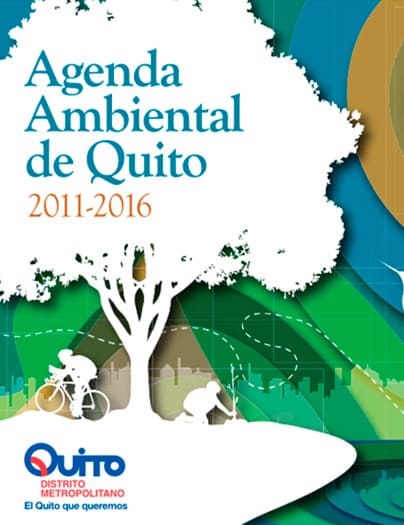
Galindo José, Gallardo Lucía, Falconí Esteban, 2012. Quito Environmental Agenda 2011 – 2016. Secretaría del Ambiente del Municipio del Distrito Metropolitano de Quito.
The environmental agenda for the metropolitan district of Quito 2011-2016 is a socio-political instrument that will guide strategic environmental management in Quito over the next five years. It is the result of a participatory process that involved more than 250 representatives of civil society and the public and private sectors and incorporates the environmental vision of various sectors.
The agenda proposes four strategic objectives and 18 measurable goals to be achieved by 2016. Both the strategic guidelines and the goals of the agenda were built in a process that included a diagnosis of the environmental situation, citizen perception surveys, 60 in-depth interviews and three construction and validation workshops. It is through the implementation of the strategies and actions proposed in this document that the 2011 – 2016 environmental agenda will be achieved.
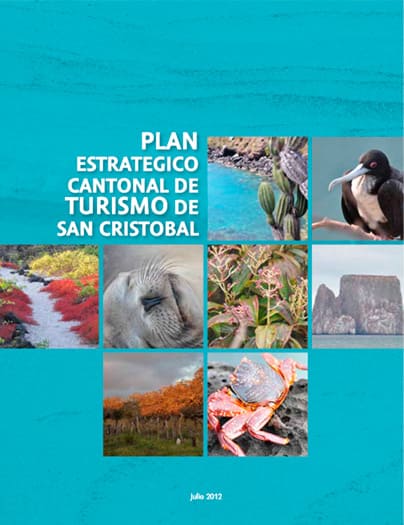
Galindo José, Rivera Juan Carlos, 2012. Strategic Tourism Plan for San Cristobal Island and Floreana Parish. Mentefactura.
The Strategic Tourism Plan for San Cristóbal responds to the need to strengthen the response capacity of cantonal institutions to implement the new management system for sustainable tourism in Galapagos. It is also a tool to guide the development of policies, programs, and projects that will make the principles of the First Galapagos Sustainable Tourism Summit a reality.
This Strategic Tourism Plan prioritizes tourism with local participation, and seeks to consolidate it as the canton’s flagship modality. It has been led by the cantonal authorities, and is aimed at the main public and private institutions that have competencies, capacities, resources and interests in tourism development. The plan presents the results of a process that involved the participation of more than eighty people in San Cristóbal and Floreana; it reflected the aspirations and needs of a broad group of organizations and individuals interested in the development of this sector.
Klearer Juerg, Galindo José. Linden Trust for Conservation, 2012. Comparative advantages of conservation trust funds and the project approach to support protected area systems. French Fund for the Global Environment (FFGE), Fondation Internationale Banc d’Arguin (FIBA), Semeia Institute. Switzerland.
This report seeks to answer the following question: Why should significant amounts of scarce and costly resources be committed to the capitalization of a CTF, with small returns in the long term, while more immediate and visible results could be achieved with direct investments in biodiversity conservation in the form of short-term projects? The focus of the study is on African and Latin American countries. The objective of the present study is to compare the advantages and disadvantages of financing through a long-term CTF mechanism versus a project financing approach to support Protected Area Systems, as well as to highlight the conditions that determine the choice of both investment options.
Cordero Sara, Galindo José. Economic sustainability within biodiversity conservation programs in Ecuador (1990-2000). Usaid 2011.
This report aims to analyze economic sustainability within biodiversity conservation programs in Ecuador. As one of the South American countries with the highest proportion of protected areas, Ecuador’s national economy is based primarily on the extraction of oil, natural gas and mining, which contribute 26.8% of the national gross domestic product (GDP). The commercialization of agricultural products (including fisheries) is another important source of economic income, accounting for 6.3% of GDP.
However, the current economic development model has been based on the unsustainable use of natural resources, resulting in the depletion and degradation of natural resources and, therefore, increasing the vulnerability of national development. Impoverished and marginalized communities living in rural areas composed of indigenous people, afro-descendants or farmers are particularly affected. limited access to basic services, infrastructure, communication and transportation is common in these areas. This combination increases pressures on the natural environment, the main source of livelihood for these populations.
UNDP. 2010. Financial sustainability scorecard for national systems of protected areas.
Protected area (PA) financing is essential for the proper management of protected areas. However, globally, protected area financing needs to be improved at both the site and system levels. Therefore, the development of a long-term financing system is a key element for PA sustainability.
The purpose of this scorecard is to help governments, donors and NGOs investigate and record significant aspects of the PA financial system – its accounts and underlying structural foundations – to demonstrate both its current health and status and to indicate whether the system is moving in a comprehensive long-term manner towards an improved financial situation. The scorecard is designed for national PA systems but could be used for sub-national systems e.g. state, regional or municipal systems or networks of Marine Protected Areas (MPAs).
Galindo José, Boscarino Enma, 2010. SINASIP Financial sustainability strategy.
The Financial Sustainability Strategy addresses a priority identified by authorities and officials of the Secretariat of the Environment of Paraguay (SEAM), serving as a complementary measure to the Strategic Plan of the National System of Protected Wildlife Areas of Paraguay (SINASIP).
This strategy is designed to counteract a critical trend characterized by limited financial resources for SINASIP, posing a threat to its overall integrity and, consequently, its capacity to effectively deliver goods and services to Paraguayan society. Notably, there is a pressing need for the incorporation of a dedicated financial sustainability and environmental economics unit within SINASIP’s organizational structure. This initiative also entails the challenge of creating institutional conditions that attract and retain skilled professionals in the areas of financial planning, marketing, and environmental economics.
Ministry of Environment Ecuador. 2010. Manglares El Morro Wildlife Refuge Management Plan. Ecuadorian Foundation for the Study of Marine Mammals (FEMM), Fundación Natura and Conservation International Ecuador. General Villamil, Ecuador.
The Gulf of Guayaquil stands as the largest estuarine complex in the country and is acknowledged as the most significant on the west coast of South America due to its substantial contribution to environmental goods and services, aligning with Ecuador’s national biodiversity policy and strategy.
Within the Gulf of Guayaquil, a pivotal area for biodiversity protection is the “Salty Estuary of Guayaquil,” named for its exposure to bodies of water with elevated salinity. Positioned in the Morro Channel, off the coast of Posorja and concluding in the city of Guayaquil, this region exhibits distinctive biodiversity characteristics.
This management plan delineates priority actions to effectively execute the management of the Salty Estuary of Guayaquil. It articulates a vision that envisions the area as a protected zone by 2023, where natural resources are conserved through sustainable ecotourism, responsible fisheries, and applied research. A key aspect of this vision is the active participation of users in the decision-making processes governing the protected area, emphasizing a cross-cutting theme of collaborative management.
Este plan de manejo identifica acciones consideradas prioritarias para efectivizar e implementar el manejo del FEMM. Se eestablece la siguiente visión: “para el año 2023, el FEMM es un área protegida cuyos recursos naturales son conservados sobre la base de un ecoturismo sustentable, una pesquería responsable y la investigación aplicada, siendo su eje transversal la participación de los usuarios en la toma de decisiones de manejo del área protegida”.
Galindo José, 2009. Sustainable Financing Plan for the Jamaica Protected Areas System (JPAS) 2010-2020.
The Financial Sustainability Plan for the Jamaican Protected Areas System aims to steer an integrated process aimed at securing stable, long-term funding for the Jamaican Protected Areas System (JPAS). It is slated to be seamlessly incorporated into the Protected Areas System Master Plan (PASMP).
This plan adopts a comprehensive perspective on costs and benefits, ensuring the acknowledgment and fair compensation for those bearing the costs of protected areas. Simultaneously, it emphasizes that those deriving benefits from protected areas (PAs) should make an equitable contribution to their ongoing maintenance. This document delineates a comprehensive approach in two critical areas: fostering an enabling environment to facilitate financial sustainability and addressing both the supply and demand sides of the conservation finance equation.
Bovarnick Andrew, Fernández Jaime, Galindo José, Negret Helen, 2010. Financial Sustainabiliy of Protected Areas in Latin America and the Caribbean: A Guide for Investment Policy. United Nations Development Program – The Nature Conservancy.
This groundbreaking report undertakes a comprehensive comparison and aggregation of financial data and qualitative information, evaluating the state of financial sustainability across protected areas (PAs) in 20 Latin American and Caribbean (LAC) countries. At the local and regional levels, the analyzed PAs collectively generate direct and indirect benefits for a population of 564 million inhabitants in these 20 countries. On a global scale, LAC PA systems play a pivotal role in sustaining crucial benefits in areas such as biodiversity conservation, human development, and increasingly, the provision of ecosystem services for carbon sequestration.
The financial sustainability of PAs has often been perceived as a “black box” by stakeholders. This report addresses that perception by offering a comprehensive set of information organized by region, sub-region, and, most significantly, by country. It reveals the extent of the funding gap between the current shortfall in funding for PA systems and a situation where these systems are sustainably supported. With this information, PA stakeholders are now equipped with a tangible target for achieving the financial sustainability of PA systems.
Financial sustainability of protected areas in Latin America and the Caribbean: A guide for investment policy.
The quantity, type, level, and immediate utility of the data presented in the full document are unprecedented. Policymakers, practitioners and researchers will find the information needed for regional and national planning, and a clear and robust analytical basis for reformulating investments to improve PA financial sustainability. While these observations reveal the level of the financial gap facing the region, they also show that bridging that gap is feasible and affordable, so that PAs can be managed cost-effectively for the benefit of all.
This pioneering report compares and aggregates official financial data and qualitative information on the state of financial sustainability of protected areas (PAs) in 20 Latin American and Caribbean (LAC) countries. At the local and regional level, the PAs analyzed generate combined direct and indirect benefits for a population of 564 million inhabitants in these 20 countries. Globally, LAC PA systems contain and sustain many important benefits in areas such as biodiversity conservation, human development and, increasingly, ecosystem services to manage carbon sequestration.
Mentefactura, Ecolex, SCL, 2007. Econometrics Ecuador Environmental Country Analysis Final Report. Quito, Ecuador
This study presents an environmental analysis of the country with an emphasis on a socioeconomic and institutional approach, and therefore does not include an exhaustive diagnosis of the state of natural resources. The study was developed within the framework of technical cooperation from the Inter-American Development Bank to the government of Ecuador.
Based on a review of the political-legal-institutional framework of environmental management, as well as a sectoral study of the economy, we reflect on the use of natural resources, analyze the environmental and social impacts generated, and review the distributive aspects arising from this process. This analysis will allow the identification of priorities under the scheme provided by the bid’s environmental strategy and their relationship with the strategies of the four priority areas defined in its institutional strategy (modernization of the state, competitiveness, social development and regional integration).
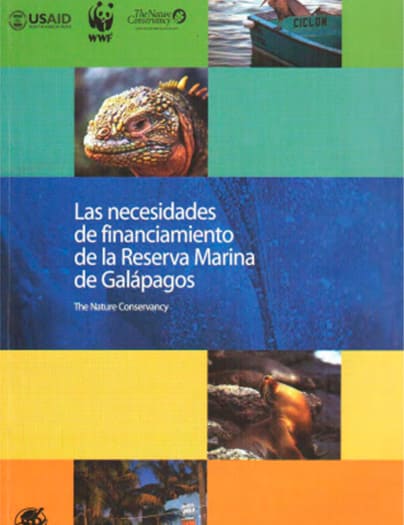
The Nature Conservancy, 2006. The funding needs of the Galapagos marine reserve. Quito, Ecuador, 42.pp.
The Nature Conservancy, within the framework of the Galapagos Marine Reserve Conservation Project, with the support of the United States Agency for International Development (USAID), has developed a study of the long-term financing needs of the Galapagos Marine Reserve.
This study presents a 10-year financing needs analysis using three scenarios: basic, medium and ideal. Each scenario represents different levels of needs, starting with the basic scenario, which involves maintaining a minimum staffing level and necessary expenses for the main processes carried out by the Galapagos Marine Reserve, up to an “ideal” scenario, which can be achieved through the fulfillment of a series of programs and processes. In any case, the different scenarios were worked on based on available information, in a joint process with the personnel in charge of activities in the marine reserve.
Galindo José, Calvopiña José, Baus Christian, Vela Sandra, Aillón María Fernanda, 2005. Analysis of the Financing Needs of the National System of Protected Areas of Ecuador. Ministry of Environment. Quito, Ecuador
This study analyzes the financing needs of the 33 natural areas of Ecuador’s National System of Protected Areas (NSPA). Special emphasis is given to the analysis of continental protected areas. This study is the first step in a sustainable financing strategy led by the Ministry of Environment of Ecuador (MEE), through the National Directorate of Biodiversity, Natural Areas and Wildlife, with the support of a broad group of non-governmental and cooperation organizations.
An important finding in the analysis of needs by scenarios is that the implementation of three additional management programs, from the basic scenario to the integrated scenario, implies a doubling of current expenditures as well as a five-fold increase in investment expenditures. This reinforces the need to identify the basic scenario as a minimum threshold for raising resources as it implies maintaining the indispensable conditions for managing the area. The additional investment of resources to implement the integral scenario has repercussions on the improvement of the state of conservation and on the capacity to multiply the benefits generated by the System to society.
Galindo José, 2003. Las Tecnologías de Información y Comunicaciones: ¿Modifican las Emisiones Contaminantes de Fuentes Móviles a la Atmósfera?” Thesis for a Master’s Degree in Environmental Management and Planning, Universidad de Chile. Santiago de Chile, October.
The objective of this research is to explore the impact of virtual mobility on the generation of pollutant emissions to the atmosphere to access procedures in banks and the Internal Revenue Service. The theoretical basis used integrates in the same plane the social consequences of the adoption of the new technology, urban sociological factors that influence the consumption patterns of transport, the modal decision process to access these procedures, and its impact on the emission of air pollutants.
A model is proposed to analyze the relationship between two alternative modes of access to the same activity, which arises from the integration of a qualitative and quantitative analysis. The study shows that it is possible to relate the use of electronic means with the emission of atmospheric pollutants associated with a specific travel motive. A marginal increase in the use of electronic means generates a significant decrease in atmospheric pollutant emissions.
Flores Marlon, Galindo José, Guillermo Rivero, 2008. Financial planning and business principles for national protected area systems: Methods, guidelines and lessons learned The Nature Conservancy, PACT, mentefactura. Arlington Virginia – USA.
The purpose of this document is to provide concepts and approaches to optimize both the financial planning processes of protected areas and the products resulting from these processes: financial needs and gaps analysis and operational financial plans, based on defined business principles and with achievable financial goals in the medium and long term. At the same time, it also seeks to promote the improvement of the institutional and individual capacity of those working on the development and implementation of PA financial plans.
In parallel, this document has been designed to support and accelerate the fulfillment of governmental commitments made at the 7th Conference of the Parties to the Convention on Biological Diversity (CBD) in February 2004, where the governments of 188 countries adopted the “Program of Work on Protected Areas”, which specifically includes aspects related to the financial sustainability of protected areas. Governments committed to “establish and initiate the implementation, by 2008, of national financial sustainability plans to support protected area systems, including regulatory, legislative, policy, institutional and other necessary reforms”. It is worth mentioning that only a small group of countries are currently meeting this target within the stipulated timeframe.